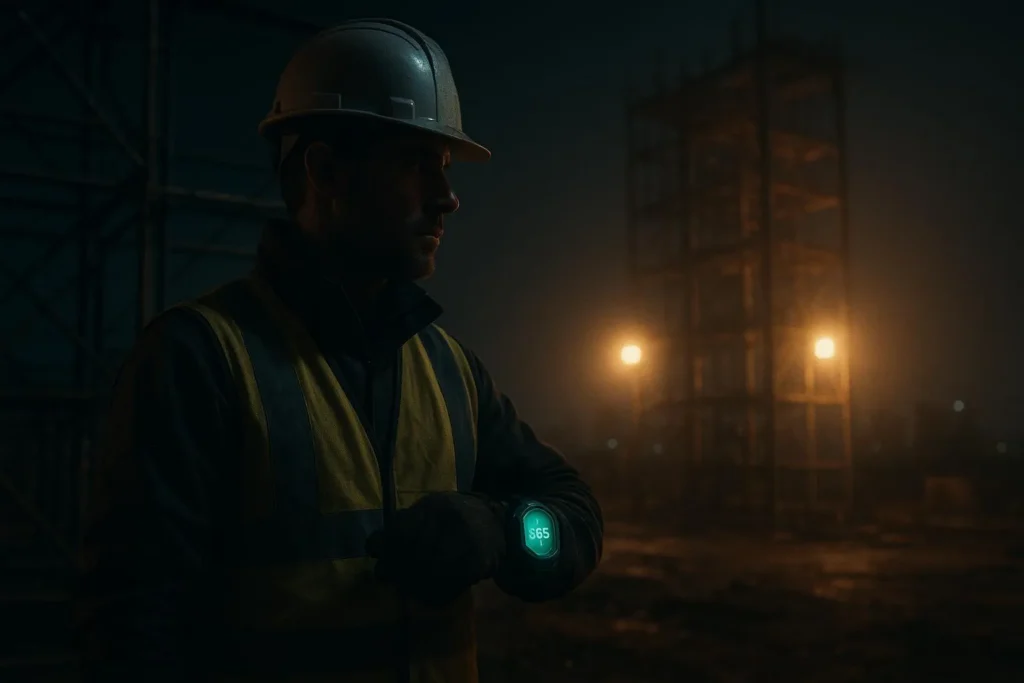
It’s 02:17 at a half-finished tower. One night-shift inspector circles the scaffold in a biting wind, logging readings and checking locks. The site is quiet—until it isn’t. A misstep on a dim stairwell, a sudden impact, a few minutes of silence. In moments like this, the difference between a nuisance alert and a verified emergency isn’t a slogan; it’s a system. This guide shows operations leaders exactly how to make SOS watches for lone workers dependable when it counts—especially on construction night shifts where steel, multipath, and dead zones can trip up even good technology.
What you’ll get here: proven ways to improve indoor/outdoor positioning, tune fall/man‑down detection to reduce false alarms, build resilient connectivity, align with monitoring center procedures, and run a deployment playbook that stands up under real conditions.
Why SOS watches for lone workers matter on construction night shifts
Construction sites at night combine isolation, environmental hazards, and variable radio conditions. Employers have a duty to manage these risks before anyone works alone. The UK regulator puts it plainly: employers must include lone workers in risk assessments and provide proportionate controls such as training, supervision/monitoring, and emergency procedures, as summarized in the Health and Safety Executive’s employer guidance and the INDG73 leaflet for lone working. See the HSE’s overview in Protect those working alone and the INDG73 guidance for employers for the formal expectations:
- HSE employer overview on lone working responsibilities and controls: according to the Health and Safety Executive’s page, employers should manage risks before people work alone and ensure suitable monitoring and emergency arrangements are in place — see the HSE’s section on employers and lone working (UK).
- HSE INDG73 leaflet summarizing proportional management for lone working: see the HSE’s INDG73 guidance for employers (UK).
These principles map neatly to the technology stack and procedures behind SOS watches for lone workers: reliable location, credible alarm verification, and a documented escalation path.
Positioning that works in steel-heavy, partly covered sites
Outdoors, multi‑constellation GNSS with assisted start-up can deliver fast, stable fixes—until steel frames, cranes, or partial sky views degrade signal quality. Indoors and below grade, traditional GPS can struggle. A robust approach blends multiple signals and carries a confidence score, so monitoring agents and supervisors know when to trust the dot on the map—and when to lean on breadcrumb trails or last‑known fixes.
- Outdoors: enable assisted-GNSS for faster time‑to‑first‑fix in cold starts. Use conservative filter settings when sky visibility drops, and transmit a breadcrumb trail during patrols so there’s context if a fresh fix is delayed.
- Indoors/below grade: combine Wi‑Fi SSID/RSSI and Bluetooth beacons where the site permits temporary infrastructure. Calibrate during night conditions (when signals and interference match real use), and re-calibrate after layout changes.
- Confidence and fallbacks: send location plus a confidence score. If confidence dips below your threshold, include last‑known and recent breadcrumbs in the same payload so ARCs can verify quickly.
- Geofences and time‑in‑zone: for after-hours patrols, set site-boundary geofences and dwell rules; if the device lingers too long in a hazard zone or outside expected paths, escalate even if a perfect fix isn’t available.
For a primer on hybrid indoor positioning, peer-reviewed reviews describe how Wi‑Fi and BLE RSS methods can reach room-level precision with careful calibration, while acknowledging sensitivity to multipath and environmental change. See the open-access comparative review on Wi‑Fi, BLE, UWB, and IMU fusion, and a recent survey of BLE indoor localization methods that discusses fingerprinting trade-offs. Also note: industrial construction environments intensify multipath; plan for on-site calibration and periodic revalidation rather than assuming office-like performance.
To connect concepts to practice, many professional wearables now support GPS, Wi‑Fi, and Bluetooth tracking in one device; see this overview of GPS, Wi‑Fi, and Bluetooth tracking to understand how hybrid signals are typically combined in smart safety wearables.
Comparative review of Wi‑Fi/BLE/UWB/IMU fusion (open access)
Survey of BLE indoor localization methods and fingerprinting trade-offs (arXiv, 2024)
GPS, Wi‑Fi, and Bluetooth tracking in professional smart wearables
Fall/man‑down detection that doesn’t overwhelm the monitoring center
The goal isn’t just sensitivity; it’s usable sensitivity. Wrist-worn devices perform differently across tasks—climbing ladders, crouching, swinging tools—and false positives often spike during manual work. A reliable configuration typically includes:
- Sensor fusion: accelerometer and gyroscope signals, posture checks, and a no‑motion timer.
- A pre‑alarm grace period: 10–30 seconds with haptic and audible feedback, so workers can cancel accidental triggers (even with gloves in noisy areas).
- Role-based profiles: scaffolders versus supervisors need different thresholds and timers.
- Continuous learning: log false alarms by activity, tune thresholds monthly, and refresh training so workers know how to cancel under stress.
Peer-reviewed studies emphasize that real-world performance varies and that lab conditions rarely mirror night-shift construction work. Rather than promising fixed accuracy numbers, implement validation drills under site-specific conditions and track metrics like detection latency, cancel rate, and verified alarms per hour of activity.
Representative literature discussing detection trade-offs and real-world false alarms can help you set expectations and design your drills:
- A peer-reviewed overview addressing sensor fusion, activity context, and algorithm variability in practice: see this open-access comparison of indoor positioning and motion fusion systems.
- A recent analysis in applied care settings reporting how task context drives false positives in wearables; while not construction-specific, it illustrates why site-specific validation matters before scale-up.
Connectivity resilience for isolated zones
Reliable alarms require reliable paths. On remote or steel-dense sites, treat connectivity as a layered system:
- Multi-operator roaming with LTE and 2G fallback: broaden coverage and minimize dead zones. Module vendors document designs that combine LTE bands with 2G fallback to improve continuity across operators and geographies.
- Store‑and‑forward: when data drops, queue SOS packets for retry. Use MQTT with QoS 1 for alerts and keep payloads compact.
- Policy-based fallbacks: if data paths fail and your SOP allows, fail over to SMS or a direct voice path to the ARC with the last-known location embedded.
- Adaptive keep‑alives: tighten during active patrols and relax when stationary to preserve battery.
- Test under duress: measure time‑to‑acknowledge and call setup in weak-signal corners of the site during the actual night shift.
For reference designs and standards, review:
- LTE module documentation that includes 2G fallback for wider roaming coverage: see u‑blox’s LTE with 2G fallback data sheet for typical capabilities and band support.
- GSMA’s multi‑SIM device requirements, which highlight behaviors and considerations for devices switching between operators.
- MQTT design patterns for intermittent connectivity and topic structure, including store‑and‑forward strategies.
u‑blox LTE modules with 2G fallback (datasheet)
GSMA TS.37 multi‑SIM device requirements (2024)
AWS IoT MQTT topic and offline patterns (whitepaper)
ARC integration and verification flow
In the UK, monitored alarm handling and graded response follow a well-defined playbook. Services certified to BS 8484 and monitored by ARCs compliant with BS EN 50518 align with the National Police Chiefs’ Council (NPCC) policy for security systems, including participation in the ECHO hub for alarm passing as forces go live. Treat BS 8484 as a best-practice code that supports robust verification and police liaison; it is not itself a legal requirement.
A practical verification flow for lone worker alarms typically includes:
- Listen-in and two‑way voice to assess the situation quickly and safely.
- Location confirmation using the current estimate plus last‑known and breadcrumb context if confidence is low.
- A tiered escalation path (site lead → on‑call HSE/safety → emergency services) with documented conditions for police contact.
- Evidence capture: recordings, timestamps, and location payloads, stored for post‑incident reviews and continuous improvement.
For the policy backbone, refer to NPCC’s Police Requirements for Security Systems (2024), which explains how accredited ARCs/RVRCs/SOCs interact with police through URNs and ECHO and sets expectations for false alarm management and eligibility for response.
NPCC Police Requirements for Security Systems (2024) — policy PDF
Practical workflow example: a night-shift false alarm and a real fall
Disclosure: Eview is our product.
02:03 — The inspector enters the stairwell. The device drops from strong GNSS to mixed Wi‑Fi/BLE with a moderate confidence score. A breadcrumb from 02:01 tags the doorway at the north scaffold.
02:05 — The worker crouches to photograph a crack. The wrist angle and deceleration look like a fall, but the pre‑alarm timer vibrates and chirps. With gloves on, the worker presses cancel. No ARC engagement; the event logs as a near‑miss false trigger.
02:17 — A real slip on a step. Impact, then no motion. The pre‑alarm vibrates, but there’s no cancel. The watch auto‑escalates: an SOS packet with current estimate + last‑known + breadcrumb, plus a man‑down flag, and opens two‑way audio.
02:18 — The ARC operator sees the medium-confidence indoor fix and the breadcrumb trail leading into the stairwell. Listen‑in yields groans; the operator attempts two‑way voice, confirms identity, and escalates to the site lead and emergency services per SOP.
02:22 — Site lead reaches the stairwell with a responder kit. The ARC maintains the call, records audio, and annotates timestamps. Later, logs and audio support the incident report and the tuning review.
Operational takeaway: the pre‑alarm window prevents nuisance escalations; confidence-scored hybrid positioning plus breadcrumbs lets operators act decisively even indoors.
Where remote policy tuning is needed across a fleet (e.g., adjusting grace-period length for night shifts), a device platform with remote configuration and FOTA streamlines change control and keeps units consistent without recall. For context on app-side policy management and updates, see these overviews of remote configuration and FOTA used in professional deployments.
Remote configuration and FOTA for managed device fleets
Firmware Over‑The‑Air in safety wearables
Deployment playbook for operations leaders
Use a short, testable sequence before scaling beyond a pilot:
- Pilot design: choose 8–15 night‑shift volunteers across roles; define success metrics (time‑to‑acknowledge, location confidence %, false alarms/hr, battery through a full shift); schedule dark-hour drills.
- Site RF survey: map GNSS shadow zones; measure Wi‑Fi coverage; propose BLE beacon placements for stairwells and basements; document and label placements for re-validation after site changes.
- Provisioning: apply role-based profiles (man‑down timers, sensitivity, pre‑alarm), geofences, and escalation trees; record device–user–SIM mapping and, where used, URN associations.
- Training and human factors: teach canceling pre‑alarms with gloves in noisy areas; practice silent/duress modes where relevant; confirm haptic/audio feedback is perceptible in PPE.
- ARC SOPs: agree verification scripts; share site maps; test audio connect time and alarm payloads in low-signal zones; verify ECHO-enabled flows where applicable.
- Post‑incident evidence: archive audio, timestamps, and location payloads; review within 72 hours; tune profiles and retrain as needed.
Vendor evaluation and ROI sanity check
Ask vendors pointed questions that focus on reliability and operations fit, not just feature lists:
- How does the device combine GNSS with Wi‑Fi/BLE indoors, and how is confidence represented to operators?
- Can you provide a pilot plan and KPIs (TTA, verified alarms, false alarms/hr) we can run on our site at night?
- What pre‑alarm options and role-based sensitivity profiles are available, and how are false positives analyzed at fleet level?
- What’s your approach to multi‑operator roaming and 2G fallback, and how do you handle store‑and‑forward for SOS payloads?
- Which ARCs you integrate with today, and how do you implement verification (listen‑in, two‑way voice, breadcrumb context)?
- Do you support remote configuration and FOTA, with audit logs for policy changes?
- What’s your integration path to our existing platform, and do you provide exportable evidence packs after incidents?
- What battery performance can we expect on a 10–12 hour night shift with tightened keep‑alives, and how do you validate that on steel-heavy sites?
FAQs
Q: How accurate are SOS watches for lone workers indoors?
A: Expect room-level rather than GPS-like precision without additional infrastructure. With calibrated Wi‑Fi/BLE and periodic revalidation, operators can get reliable location context. Confidence scoring, last‑known fixes, and breadcrumb trails are essential to bridge gaps.
Q: Why do fall detectors false-trigger on construction tasks?
A: Rapid wrist angles, tool vibrations, and abrupt crouches mimic falls. Sensor fusion plus a short pre‑alarm grace period allows workers to cancel without overwhelming ARCs. Role-based profiles and monthly tuning help further reduce nuisance alerts.
Q: When should we consider UWB?
A: If the site can fund and maintain anchors in critical areas (e.g., basements with dense steel) and you need sub‑meter precision for rescue teams. For many projects, well-planned BLE/Wi‑Fi with breadcrumbs and clear SOPs offers sufficient context at lower cost.
Q: Is BS 8484 mandatory?
A: No. It’s a recognized best-practice code in the UK for lone worker services. Certification, combined with ARCs operating to BS EN 50518 and NPCC policy, supports prioritized, verifiable escalation.
Closing thoughts
If you remember one thing, make it this: reliability is designed, not declared. Hybrid positioning with confidence and breadcrumbs, tuned man‑down detection with a cancel window, resilient connectivity with clear fallbacks, and ARC-aligned procedures—all exercised in realistic drills—turn SOS watches for lone workers into a dependable safety net. Use the playbook above, run the night-shift pilot, and keep iterating based on evidence. When you’re ready to standardize policies across a fleet, ensure your platform supports remote configuration and FOTA so improvements stick across every device.