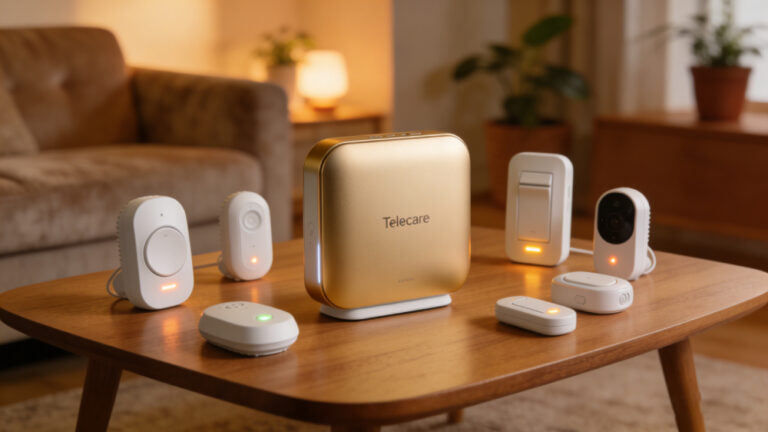
If you’re responsible for selecting or integrating mobile personal emergency response systems (mPERS) for older adults, you’re balancing safety outcomes, compliance, and operational reality. This mPERS buying guide is written for telecare/mPERS brands, monitoring centers (ARCs/CMS), senior living and home‑care providers, and systems integrators who need a practical path to reliable fall detection, indoor–outdoor positioning, and smooth monitoring‑center workflows.
The market continues to expand as connectivity and sensors mature, but real‑world performance still hinges on integration details and pilot discipline. According to the industry analysis by Mordor Intelligence (2026) on medical alert systems, mobile PERS remains a fast‑growing segment—useful context, though buyer decisions should rest on technical fit and field validation.
What “good” looks like in mPERS for 2026
For senior safety programs, success is measured by outcomes—not feature lists. Aim for these characteristics:
- Dependable alarm delivery with clear acknowledgements and retries across your chosen protocol stack (SIA DC‑09, Contact ID/Sur‑Gard, or modern web transports), plus two‑way voice that operators can actually hear.
- Indoor–outdoor location continuity with room/zone awareness indoors and street‑level positioning outdoors, tuned to your environment and power budget.
- Fall detection you can validate—transparent methods, user‑cancel windows, man‑down/inactivity logic, and sensible escalation trees.
- Certifications and privacy foundations that accelerate market access (FCC/CE/RED/UKCA/RCM, PTCRB/carrier approvals; GDPR, and HIPAA only if PHI enters covered workflows).
- Fleet operations that scale: remote configuration, FOTA with rollback, diagnostics, and a playbook for pilots → production.
Monitoring‑center integration essentials
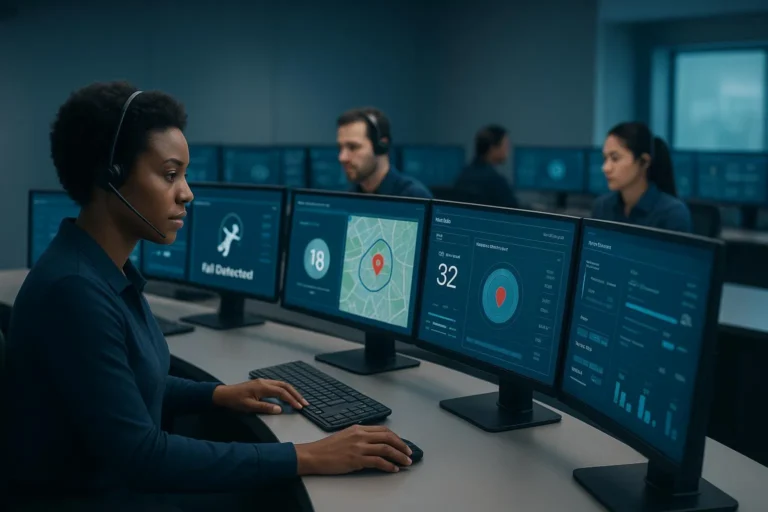
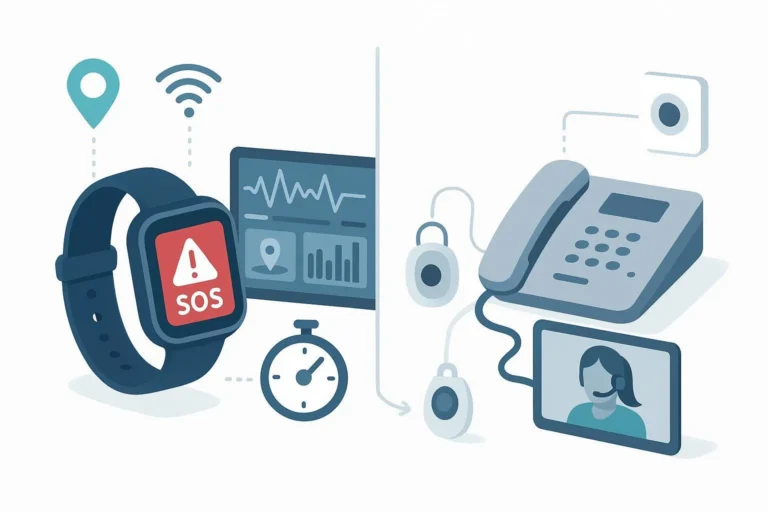
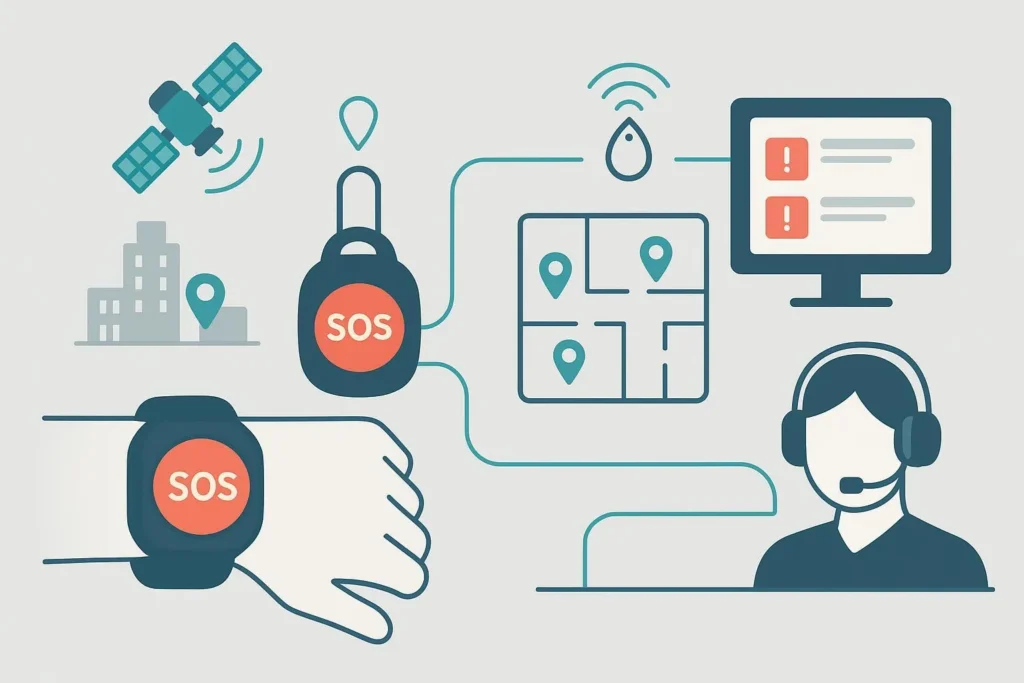
mPERS value crystallizes inside the ARC/CMS workflow. You’re moving events and audio across two distinct planes: alarm signaling and two‑way voice.
SIA DC‑09 and Contact ID/Sur‑Gard
- ANSI/SIA DC‑09 (IP event reporting) is widely supported in modern receiver stacks and provides structured messaging and acknowledgements for alarms, restores, tests, and supervision. See the overview from the Security Industry Association in DC‑09‑2021 | SIA DCS—Internet Protocol Event Reporting and its standards index for context.
- Legacy but ubiquitous, Ademco Contact ID (SIA DC‑05) persists via dial capture or IP bridges to Sur‑Gard receivers. Many platforms run mixed fleets; vendor documentation such as Ajax Systems’ technical note on confirmed alarms with SIA DC‑09 and Contact ID illustrates the practical coexistence.
Modern web transports and receivers
- Some ARC infrastructures accept HTTPS REST APIs, MQTT telemetry, and webhooks alongside DC‑09/CID for richer context (GPS payloads, battery, geofences). The IRIS‑4 Technical Reference Manual from AddSecure provides a helpful window into IP receiver capabilities used in monitoring centers.
A minimal example of a JSON event payload your ARC/CMS might ingest via webhook or REST could look like:
{
  "device_id": "MPERS-7234",
  "event_type": "fall_suspected",
  "timestamp": "2026-02-04T13:27:18Z",
  "position": {"lat": 40.7441, "lng": -73.9903, "source": "BLE+GNSS", "accuracy_m": 3.2},
  "battery_pct": 62,
  "user_cancel_window_s": 20,
  "voice_channel": {"method": "SIP", "uri": "sip:7234@arc.example"}
}
Two‑way voice (SIP/VoIP)
- For voice, most ARCs operate SIP‑based telephony. Ensure your devices support high‑quality audio with acoustic echo cancellation (AEC), and your network marks RTP with appropriate QoS. While it’s a telecom staple rather than an mPERS‑specific spec, SIP fundamentals originate with IETF RFC 3261; many ARC platforms pair SIP calls with recording and metadata for QA, as discussed by industry providers such as CSS Aeonix in their SIP recording operations overview for central stations.
Practical testing tips
- Validate DC‑09/CID with failure injection: simulate packet loss, force retries, and confirm acknowledgements at the receiver.
- Measure end‑to‑end latency: trigger → receiver display → operator accept → voice path established.
Indoor–outdoor positioning playbook for senior care
Don’t pick a single technology; design a fusion. Outdoors, GNSS (GPS/Galileo/GLONASS/BeiDou) provides street‑level accuracy. Indoors, Wi‑Fi, BLE, and sometimes UWB or Wi‑Fi RTT carry the load. The goal is smooth continuity and room/zone context in the places that matter.
What the literature and industry say
- An accessible industry synthesis explains trade‑offs among BLE, Wi‑Fi fingerprinting, and Wi‑Fi RTT, including infrastructure vs calibration burdens and realistic accuracy/coverage expectations. See Crowd Connected’s 2025 indoor positioning tech update.
- Academic reviews surveyed multiple methods and typically report Wi‑Fi around ~2–5 m, BLE in the ~1–5 m range (depending on beacon density and fusion), and UWB in the ~0.1–0.5 m band with higher infrastructure cost. A comprehensive open‑access survey is available in Sensors (2024) on indoor positioning systems.
- For a cost/accuracy/energy comparison between BLE and UWB at the system level, refer to the RTLS Alliance’s BLE vs UWB deployment comparison (2025).
Practical deployment recipes
- Home‑care programs (low infrastructure): GNSS outside; indoors, rely on Wi‑Fi SSID scans for rough zone context and a handful of BLE beacons placed at entryways, stairs, and bathrooms. This keeps costs down while improving threshold events (e.g., doorway/stairwell handoffs).
- Assisted‑living communities: A modest BLE beacon grid in corridors and rooms, fused with IMU‑based pedestrian dead reckoning (PDR), usually yields predictable 2–5 m with good battery economy. Consider selective UWB at high‑risk spots (stairs, exits) where <30 cm is valuable.
- Hospital/campus settings: If your enterprise Wi‑Fi supports 802.11mc/FTM today or 802.11az going forward, Wi‑Fi RTT can boost accuracy; verify AP and client support before committing.
For a practitioner’s take on beacon planning around doorways and high‑risk zones, see this internal perspective on indoor positioning in practice for SOS watches.
Calibration and battery realities
- Fingerprinting needs site surveys and re‑surveys after renovations; budget engineering hours accordingly.
- Beacon density drives battery draw: more scans and higher Tx power mean shorter device life—quantify in your duty‑cycle model.
- Handoffs at thresholds (doors, elevators) deserve lab time; you want stable transitions, not location “ping‑pong.”
Fall detection you can trust
No algorithm is perfect in free‑living conditions, and that’s okay—transparency and workflow design are what make the difference.
What the evidence shows
- Peer‑reviewed work continues to report high sensitivity and specificity in controlled or semi‑controlled trials, but many studies remain small or lab‑based. For example, a 2025 study combining wearable sensors with networked reporting reported very high sensitivity/specificity with a small cohort; useful methodologically, but not a guarantee of field performance. See a 2025 Sensors article on wearable fall detection performance and a broader 2025 review of wearable fall detection progress. Treat figures as starting points, not promises.
How to validate before rollout
- Design free‑living pilots with diverse seniors (assistive devices, gait differences) across target environments.
- Use leave‑one‑subject‑out (LOSO) during development; keep a hold‑out cohort for validation.
- Track sensitivity, specificity, precision/F1, false alarms per device‑day, and time‑to‑acknowledge by ARC. Log user‑canceled events and “no‑motion” escalations.
Workflow features that help
- Provide a short user‑cancel window with clear haptics/voice prompts.
- Add inactivity/man‑down logic to catch slow falls or collapses.
- Route events with the best available location context and recent breadcrumb trail to speed operator triage.
Connectivity and two‑way voice reliability
Coverage and audio quality are table stakes—and frequent sources of field pain.
- Cellular: Favor LTE with VoLTE support and roaming/eSIM options where appropriate. Verify band coverage for your countries of operation and plan for 2G/3G sunset realities. Measure call setup time and retry behavior under marginal signal.
- Voice quality: Test acoustic echo cancellation, speaker volume, and mic placement in noisy real‑world scenarios. Ensure SIP security (TLS/SRTP where supported) and QoS markings end‑to‑end. For context on how ARC receivers and IP stacks operate in practice, the IRIS‑4 technical reference is a useful benchmark.
Certifications, approvals, and data protection
Regulatory compliance isn’t optional; it’s your ticket to market and a proxy for engineering rigor.
Market access and radios
- United States: FCC equipment authorization covers cellular, Wi‑Fi, and BLE radios and SAR for wearables. See the FCC’s equipment authorization overview.
- European Union: CE marking under the Radio Equipment Directive 2014/53/EU governs health/safety, EMC, and spectrum use—plus RoHS/REACH. Reference the text of RED 2014/53/EU.
- UK and AU/NZ: UKCA for the UK and RCM for Australia/New Zealand follow similar principles. Government primers at UKCA marking guidance and ACMA RCM labeling offer scope and labeling details.
- Cellular interoperability: PTCRB (and sometimes GCF) plus carrier‑specific approvals are commonly required for LTE devices. See PTCRB’s program overview. For a concrete vendor example of how certifications bundle across regions and carriers, review Teltonika’s certificates overview.
Data protection
- GDPR applies to personal and location data in the EU. HIPAA applies in the US only if protected health information flows within covered entities and BAAs—many mPERS deployments aren’t HIPAA‑covered but still require strong privacy and security. Document DPAs/BAAs as contract needs dictate.
ODM/OEM and remote fleet management: when customization pays off
Customization can reduce time‑to‑adoption and integration pain—but only if you bind it to operations.
What to customize
- Firmware and UI: Alarm logic, prompts, voice languages, LED/haptics, event schemas, and integration hooks (REST/MQTT/webhooks) should align with your ARC workflows.
- Enclosure and wearability: Comfort, IP rating (IP67+ is common for wearables), charging ergonomics, and accessibility for seniors.
- Packaging and collateral: Regulatory markings, user instructions, and quick‑start guides aligned to the program.
Remote configuration and FOTA
- Require secure remote configuration (APN/server, reporting intervals, SOS contacts, geofences) and a well‑run FOTA program.
- Follow staged rollouts with explicit rollback: progressive cohorts and health checks dramatically reduce risk in safety fleets. See this OTA guide on staged testing and rollback strategies from Memfault’s OTA testing overview (2025).
A neutral, practical example
- Disclosure: Eview is our product. In deployments where partners needed multilingual voice prompts and specific ARC escalation payloads, we’ve seen OEM/ODM firmware customization combined with a remote FOTA platform shorten integration timelines and reduce field visits, while still keeping protocols compatible with existing receivers. For a high‑level overview of OEM/ODM and remote management options in elderly telecare programs, see this solution page describing elderly telecare customization and fleet tools.
Pilot and procurement checklist (for your RFP and SOW)
Use this as a living document during vendor selection and pilot execution.
- Integration: Confirm DC‑09/CID support and/or REST/MQTT/webhooks; request sample payloads and error handling docs.
- Voice: Verify SIP/VoLTE support, AEC capability, MOS testing plan, and recording/QoS policies with your ARC.
- Location: Define target indoor accuracy and infrastructure plan (BLE/RTT/UWB), calibration steps, and maintenance budget.
- Falls and safety: Require validation protocol (LOSO + hold‑out cohort), user‑cancel windows, and man‑down logic; report false alarms per device‑day.
- Hardware: Battery life under your duty cycle, IP rating, charge cradle design, haptics/LEDs, button ergonomics.
- Approvals: Regulatory (FCC/CE/RED/UKCA/RCM), cellular (PTCRB, carrier), SAR, RoHS/REACH, UN38.3.
- Security & privacy: Secure boot, signed firmware, TLS/mTLS, audit logs; GDPR compliance; HIPAA only if applicable.
- Fleet ops: Remote configuration scope, FOTA cadence/rollback, diagnostics, RMA/warranty terms, support SLAs.
- KPIs: Alarm latency P50/P95, location error indoors/outdoors, false alarm/device‑day, call setup time, FOTA success rate.
How to use this mPERS buying guide in your program
You’ve seen how the pieces fit: protocols and receivers, indoor–outdoor positioning, fall detection validation, approvals, and the very practical world of FOTA and remote configuration. Treat this mPERS buying guide as a framework you can tune to your residents, caregivers, and ARC capacity.
For deeper dives into related topics and ongoing updates, explore the Eview blog hub for PERS and mPERS articles.
References and further reading
- Standards and receivers: DC‑09‑2021 overview by SIA; IRIS‑4 Technical Reference Manual (2024); Ajax Systems note on DC‑09 and Contact ID.
- Indoor positioning: Crowd Connected 2025 update; Sensors (2024) survey of indoor positioning systems; RTLS Alliance BLE vs UWB comparison (2025).
- Certifications and market context: FCC equipment authorization; RED 2014/53/EU; PTCRB overview; Teltonika certificates overview; Mordor Intelligence 2026 market analysis.