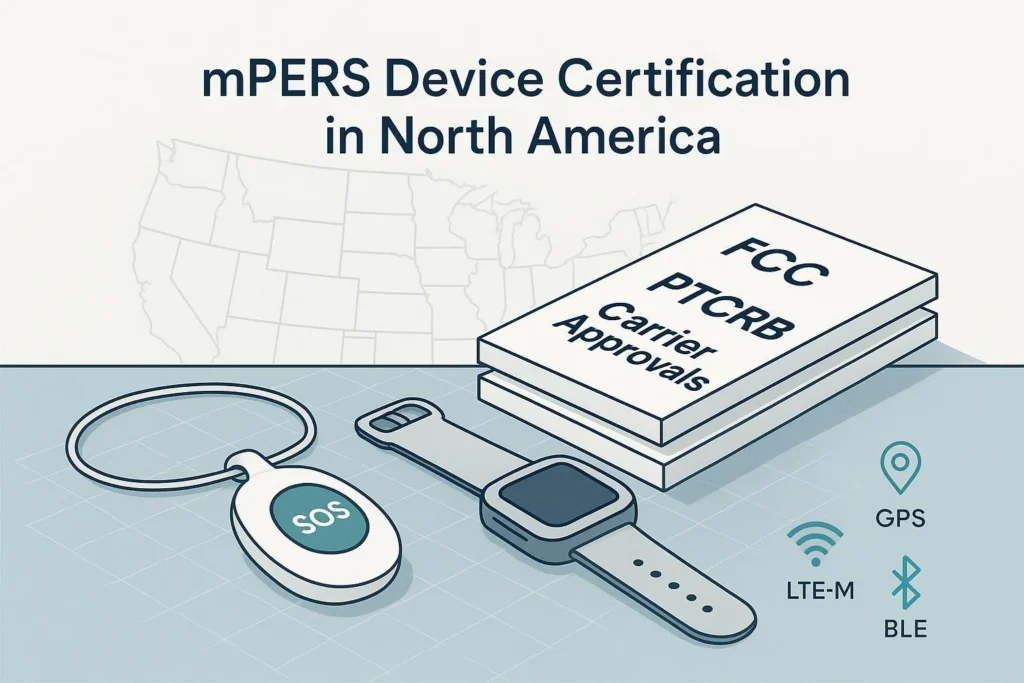
If you lead an mPERS program in North America, you already know the real obstacle is not building a prototype—it is proving that your device can clear FCC, pass PTCRB, secure carrier approvals, and then hold steady in healthcare or government SLAs as volume ramps. This guide lays out an implementation-first path with links to primary sources and a practical checklist you can use in RFPs and pilots.
The North American path to market for mPERS FCC PTCRB certification
For mPERS wearables, the sequence is straightforward but unforgiving: FCC equipment authorization, PTCRB certification, and then operator approvals with field validation. Think of it as three gates that build on each other; miss a requirement early and the delay compounds downstream.
| Phase | Typical timeline | Key dependencies | Notes |
|---|---|---|---|
| FCC equipment authorization | 4–8 weeks after lab slots | SAR for body‑worn use; exhibits completeness | Certification under Part 2 Subpart J; labeling and user info must align with tested configs |
| PTCRB certification | 3–8 weeks depending on labs | FCC done or in progress; stable RF and firmware | Covers 3GPP conformance and OTA performance; choose a CTIA/PTCRB Authorized Test Lab |
| Carrier approvals | 3–10+ weeks by operator | FCC + PTCRB completed; IMEI onboarding; FOTA readiness | Verizon OD, AT&T device approval or FirstNet, T‑Mobile partner approval; field trials are typical |
| Pilot to scale | 4–12 weeks pilot; rolling ramps | Monitoring-center integration; KPI thresholds | Lock firmware baseline, define FOTA gating, enforce IMEI controls and SLA reporting |
FCC certification for mPERS wearables
Your first gate is the Federal Communications Commission. LTE/LTE‑M mPERS devices that transmit in licensed bands follow the Certification procedure, documented in the federal rules. The core authority sits in the equipment authorization rules, with additional service parts for cellular bands.
- Required exhibits and elements for a body‑worn mPERS device typically include: test reports for relevant service parts, SAR evaluations for portable exposure, labeling and user manual content, internal and external photos, schematics, and operational descriptions tied to tested antennas and accessories.
Two references matter most here. The overarching equipment authorization framework resides in the federal rules for equipment authorization under Part 2 Subpart J, which sets how devices are certified, labeled, and documented. The specific SAR obligation for portable transmitters—like pendants and wrist devices within 20 cm of the body—appears in the SAR section for portable devices.
- See the federal rules in the equipment authorization section: the reference for equipment authorization procedures under Part 2 Subpart J is in the eCFR, which outlines Certification, labeling, and user information requirements. Consult the section titled Equipment Authorization: Subpart J at the eCFR.
- Review the specific SAR provision for portable devices in the eCFR section on specific absorption rate to understand when and how body‑worn testing applies.
Authoritative references:
- According to the eCFR equipment authorization rules under Part 2 Subpart J, Certification is the pathway for licensed service radios, and labeling and user information are prescribed in those rules: see the Equipment Authorization procedures in the eCFR.
- For RF exposure, the SAR obligation for portable devices is set in the eCFR section on specific absorption rate for portable devices.
Equipment Authorization procedures in the eCFR (Part 2 Subpart J) • eCFR section on specific absorption rate for portable devices (§2.1093)
Practical implications for mPERS:
- Plan SAR at very small separations that match the intended wear position, evaluate simultaneous transmission if LTE and Bluetooth or Wi‑Fi can be active together, and ensure your manual language mirrors the tested accessories and positions. Small changes to the antenna or RF path later may trigger retesting; control change management early.
PTCRB: From 3GPP conformance to OTA performance
Once FCC is in motion, move to PTCRB. PTCRB is the operator‑founded program administered by CTIA that verifies 3GPP conformance and radiated performance for devices and modules. In practice, North American carriers treat PTCRB as a prerequisite for network approval.
Key actions:
- Select a CTIA/PTCRB Authorized Test Lab based on your band and mode matrix and their chamber capacity for OTA/TRP/TIS. Lock your firmware baseline before formal testing, and avoid last‑minute RF design changes.
- If you are using a pre‑certified module, confirm the exact antenna implementation and supported bands match the module’s certified configurations; mismatches can negate module credit and force additional testing.
Useful primary resources:
- PTCRB’s program overview explains scope and governance, including how IoT devices inherit some coverage from certified modules but still require end‑device validation where applicable. See the PTCRB overview.
- CTIA maintains directories of Authorized Test Labs you can contact directly for schedules and capability. See the CTIA test labs directory.
PTCRB program overview • CTIA Authorized Test Labs directory
Expect common delays from lab queueing, antenna tuning drift between EVT and DVT builds, and firmware regressions that alter RF behavior. Mitigate by booking chambers early, freezing RF‑affecting changes ahead of test, and running a pre‑screen at your SI partner or a smaller anechoic facility before formal runs.
Carrier certification requirements by operator
With FCC and PTCRB in hand, you tackle the operator layer. The sequence and requirements differ by network, but the pattern is predictable: documentation review, lab or field conformance, and limited‑scale activations for validation. This is where the secondary search intent—carrier certification requirements—becomes the practical roadmap.
Verizon Open Development
Verizon’s Open Development program requests prior FCC compliance and PTCRB. Devices proceed through submission, testing at an authorized lab, and field validation. You will also be asked to document firmware update capability at the radio layer, since over‑the‑air updates are expected for LTE‑class devices, and to upload device identifiers such as IMEI ranges as part of onboarding.
- Program entry point: see Verizon’s get‑certified page for process steps, materials, and portal access.
Verizon Open Development get‑certified page
AT&T device approval and FirstNet for public safety
AT&T publishes radiated performance thresholds for IoT devices, with specific TRP and TIS targets. After meeting those thresholds and completing PTCRB, devices undergo network validation with onboarding artifacts. If your target market includes public safety, FirstNet adds additional validation for devices supporting Band 14 and relevant security controls.
- Review the latest performance thresholds in AT&T’s Radiated Performance Requirements for IoT Devices.
- FirstNet device program information and catalogs are maintained by the FirstNet Authority and AT&T.
AT&T Radiated Performance Requirements for IoT Devices • FirstNet Authority device program page
Reality check for 2026 planning: industry reporting indicates AT&T has prioritized LTE‑M and is advancing 5G RedCap for mid‑tier IoT. If you are still considering NB‑IoT for new mPERS products, validate availability and certification paths with AT&T first.
T‑Mobile partner approval
T‑Mobile provides device approval via partner and developer programs. While full criteria are furnished via partner engagement, the pattern mirrors the others: FCC and PTCRB first, then conformance and field validation with IMEI onboarding and limited activations. Initiate contact through the business IoT or developer channels and confirm which radiated performance targets apply to your device category.
RFP‑ready compliance checklist for healthcare and government
Use this prioritized checklist to assemble evidence packages for buyers and monitoring centers. Keep it ready before pilots; it shortens legal and security reviews and avoids late surprises.
- FCC grant and exhibits set, including SAR reports aligned with body‑worn use, labeling screenshots, and prescribed user information language.
- PTCRB certificate matching your exact SKU, antenna, and firmware baseline; test reports for TRP/TIS where applicable.
- Operator artifacts: Verizon OD onboarding materials with IMEI ranges and FOTA documentation; AT&T radiated performance results and onboarding forms; FirstNet evidence if targeting public safety; T‑Mobile partner confirmation of entry path.
- IMEI management plan and whitelisting status if applicable; serialization controls tied to firmware baselines; procedure for lost or stolen units.
- FOTA policy and rollback plan; baseline locking and gating criteria for release to production; audit trail for updates during pilots.
- Monitoring‑center integration note covering ANSI/SIA DC‑09 or Contact ID mapping, encryption keys, keepalive intervals, and event taxonomy including GPS coordinate fields.
- Supply‑chain attestations relevant to telecom authorization, including conformance with current FCC restrictions on covered entities and component vetting.
Pilot to scale SLAs: what to measure and how to hold the line
Pilots should mirror production, not a lab curiosity. Define acceptance thresholds up front and document the controls that keep those results stable as you ramp.
Service levels to track:
- Uptime and offline rate: target at least 99.0% network availability at the fleet level, with a rolling daily offline rate under 1.5% as an operational trigger.
- SOS path reliability and latency: aim for 99.5% successful delivery to the platform with a five‑second or better delivery target under typical LTE‑M coverage.
- Hardware stability: keep RMA rates under 1.0% during pilot; investigate any RF‑related returns for antenna or assembly drift.
- Radiated performance: confirm TRP and TIS remain within operator thresholds on CTQ or sample audits after design freezes.
Operational guardrails:
- IMEI onboarding and controls: bind IMEI ranges to firmware baselines; never mix unapproved builds into field trials.
- FOTA gating: require a release checklist before any update moves beyond a small canary group; prohibit RF‑affecting changes during active carrier testing unless you have explicit lab concurrence.
- Monitoring‑center integration: implement ANSI/SIA DC‑09 cleanly and align on account codes, event types, encryption, and keepalive intervals. The Security Industry Association published an open‑source Java library in 2025 that can reduce implementation friction; for the full standard, purchase through SIA. See the SIA announcement of the DC‑09 open‑source library.
SIA announcement of the DC‑09 open‑source library
Example workflow with an ODM partner
Disclosure: Eview is our product. As an illustrative example, an ODM partner like Eview would stage the program by freezing RF‑affecting changes ahead of FCC testing, booking PTCRB chambers once SAR and RF pre‑screens look clean, and preparing Verizon OD materials in parallel—IMEI ranges, radio‑layer FOTA capability, and test lab scheduling—so carrier validation starts promptly after PTCRB issuance. The same workflow applies with AT&T or T‑Mobile, with FirstNet considerations added when public safety is in scope. Alternatives include any ODM with PTCRB experience and ISO‑certified production.
Common pitfalls and how to avoid them
Teams often under‑specify SAR for body‑worn positions; align test separations with real accessories and usage to avoid re‑test. Module selection does not eliminate end‑device work; ensure your antenna and band plan match the module’s certified configurations. Firmware changes that touch the radio stack after PTCRB can trigger regressions; lock a baseline and operate FOTA with gates. IMEI onboarding late in the project slows field trials; prepare ranges and portal access early. Finally, pilots without SLA metrics and change control turn into anecdotes; write down thresholds and escalation paths, then stick to them.
Next steps and resources
If you are within a quarter of pilot launch, line up your exhibits now: FCC grants and SAR reports, PTCRB certificate, operator onboarding artifacts, IMEI ranges, FOTA policy, and monitoring‑center integration notes. Book conversations with two CTIA/PTCRB labs to compare queue times, and contact the operator programs appropriate to your bands and markets. If an ODM partnership will accelerate execution, speak with a vendor that can show a documented certification history and ISO‑certified production.
Primary references to bookmark:
- See the federal Equipment Authorization procedures in the eCFR for Certification, labeling, and user information requirements under Part 2 Subpart J. Here is the canonical page: Equipment Authorization procedures in the eCFR (Part 2 Subpart J)
- Review the eCFR provision on specific absorption rate for portable devices to plan SAR testing for pendants and wrist devices: eCFR section on specific absorption rate for portable devices (§2.1093)
- Understand PTCRB scope and governance: PTCRB program overview
- Find and contact Authorized Test Labs: CTIA Authorized Test Labs directory
- Begin Verizon operator approvals here: Verizon Open Development get‑certified page
- AT&T radiated performance thresholds for IoT: AT&T Radiated Performance Requirements for IoT Devices
- Public safety path and device information: FirstNet Authority device program page
- DC‑09 implementation context and library: SIA announcement of the DC‑09 open‑source library
Looking ahead, the hardest part of an mPERS rollout is not the lab work but the discipline to keep RF, firmware, and operations in sync as you scale. Set conservative gates, measure what matters, and your certifications will translate into real‑world reliability.