Author & Review Statement
Written by Daniel Harper
Digital Health Technology Analyst | 12+ years’ experience in IoT connectivity, telecare system design, and global digital telecare migration strategy projects.
This article references publicly available data from:
- Global digital transformation frameworks
- GSMA IoT healthcare connectivity reports
- Industry reports on telecare IoT adoption (2024–2025)
Introduction
Telecare IoT is becoming central to digital healthcare infrastructure as analogue networks are retired and care services transition to IP-based telecare systems worldwide.
The global push for digital telecare adoption aligns with Telecare IoT as a solution for monitoring remote safety, ensuring proactive care, and improving real-time healthcare delivery.
Search intent for “Telecare IoT” increasingly reflects technical and strategic queries such as:
- telecare IoT deployment model
- telecare IoT infrastructure requirements
- Telecare IoT compliance framework
- global digital telecare migration strategy
- PSTN retirement telecare impact
- resilient IoT healthcare connectivity
This guide addresses these deeper technical, operational, and regulatory questions — not just a surface-level definition.
What Is Telecare IoT?
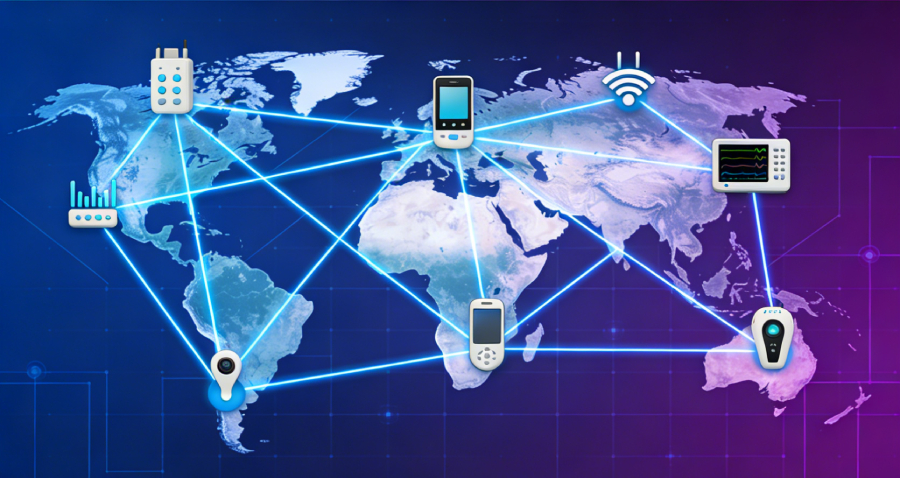
Telecare IoT refers to connected telecare systems that use IoT-enabled care devices, secure connectivity layers, and cloud-based analytics platforms to monitor safety, behavior, and environmental risks in assisted living environments.
Unlike traditional analogue alarm systems, IoT in telecare enables:
- Continuous remote monitoring of IoT data flows
- Smart home healthcare integration
- Automated escalation workflows
- Real-time analytics
- Connected care ecosystem interoperability
It represents the foundation of modern IP-based telecare systems, replacing outdated analogue infrastructure, aligning with global digital transformation efforts.
PSTN Retirement & Telecare Impact Worldwide
The PSTN retirement programme is a global trend, with multiple countries retiring analogue systems in favor of more resilient and scalable IP-based connectivity.
PSTN Retirement Telecare Impact Includes:
- Analogue alarm units are becoming incompatible
- Increased risk of call failures over digital lines
- Power dependency changes (no line-powered devices)
- Urgent need for a digital telecare migration strategy across countries
Telecom regulators and service providers are urging sectors such as healthcare and social care to migrate to digital solutions before the final switch-off of PSTN infrastructure.
This regulatory shift is one of the primary drivers behind Telecare IoT adoption, impacting telecare providers worldwide.
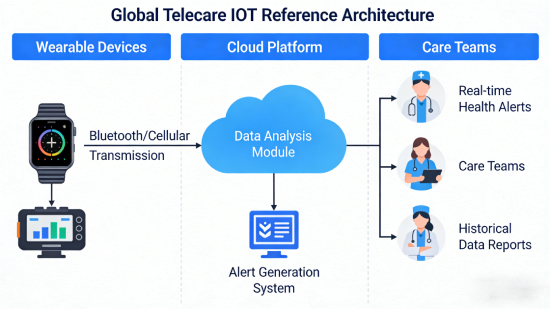
Telecare IoT Reference Architecture
Below is a standard Telecare IoT reference architecture used in global deployments:
IoT Sensors & Wearables
↓
Home Gateway / Edge Device
↓
Secure Connectivity Layer
(LTE-M / NB-IoT / Multi-network SIM / IP)
↓
Cloud IoT Platform
↓
Analytics & Risk Engine
↓
Monitoring Centre Platform
↓
Care Team / Responder Network
Layer-by-Layer Explanation
Device Layer
- Fall detection pendants
- Door sensors (dementia exit alerts)
- Environmental hazard sensors
- Smart medication devices
Edge Layer
Edge computing ensures:
- Local alert fallback
- Latency reduction
- Short-term buffering during outages
Connectivity Layer
Resilient IoT healthcare connectivity requires:
- Roaming or multi-network SIM
- Encrypted TLS data transport
- ≥99.9% uptime SLA
- Battery backup integration
Cloud & Monitoring Layer
- Event normalization
- Behavioural analytics
- Monitoring workflow automation
- Integration with care management systems
Telecare IoT Infrastructure Requirements
A successful telecare IoT deployment model must include:
Network Infrastructure
- Strong indoor cellular coverage
- Backup communication channel
- Signal resilience testing
Device Infrastructure
- Medical-grade certifications
- Remote firmware update capability
- 5–10 year lifecycle planning
Platform Infrastructure
- Cloud-native scalability
- API-first integration
- Data redundancy and disaster recovery
Operational Infrastructure
- 24/7 monitoring capacity
- Escalation protocols
- SLA enforcement mechanisms
These telecare IoT infrastructure requirements are becoming increasingly critical in international care sectors and have been adopted by leading healthcare markets.
Telecare IoT Deployment Model Options
Care providers typically adopt one of three telecare IoT deployment models:
Model 1: Fully Managed Service
Connectivity + platform + monitoring outsourced to one vendor.
Model 2: Hybrid Deployment
Provider owns a monitoring platform; connectivity and device fleet managed by a specialist IoT operator.
Model 3: Modular Infrastructure
Best-of-breed architecture integrating:
- Independent IoT connectivity provider
- Separate device vendor
- Dedicated cloud analytics partner
Modular deployments allow greater resilience but require strong integration governance.
Telecare IoT Compliance Framework
Operating within a healthcare-adjacent domain means compliance is critical.
A telecare IoT compliance framework typically covers:
- GDPR data protection
- Data retention policy
- Secure device provisioning
- Role-based system access
- Audit trail logging
- Incident reporting obligations
For global deployments, alignment with local healthcare regulations (e.g., GDPR, HIPAA) ensures legal compliance and data privacy protection.
Real-World Telecare IoT Deployment Example (Global Case, 2024–2025)
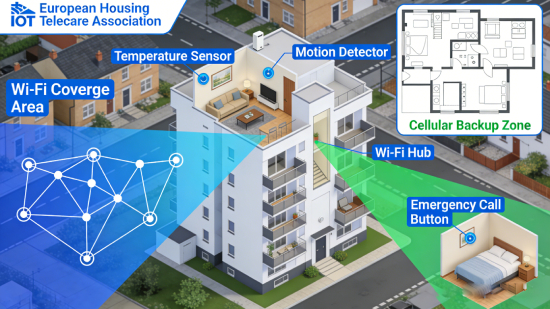
Case: European Housing Association (Aggregated Sector Data Reference)
Between 2024 and 2025, multiple housing providers across Europe accelerated digital telecare migration due to PSTN retirement timelines.
Based on aggregated global digital migration case data (2024–2025 sector reports):
- Over 5,000 analogue alarm units were replaced
- LTE-M-based IP telecare devices deployed
- Multi-network resilient SIM connectivity adopted
- Cloud-based monitoring dashboards implemented
Reported outcomes:
- 30–40% reduction in failed call attempts during testing
- 99.96% average connectivity uptime
- Improved remote device diagnostics
Note: Figures represent aggregated sector reporting across international housing digital migration initiatives.
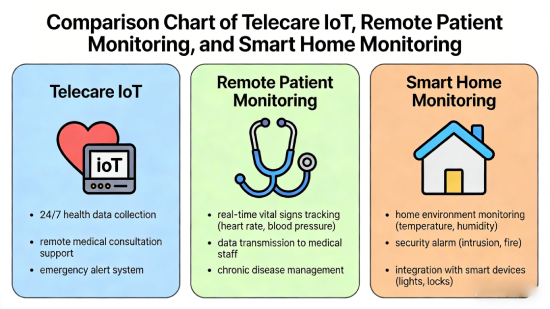
Telecare IoT vs Remote Patient Monitoring vs Smart Home Monitoring
| Category | Telecare IoT | Remote Patient Monitoring | Smart Home Monitoring |
|---|---|---|---|
| Primary Goal | Independent living safety | Clinical data tracking | Convenience & automation |
| Connectivity | Resilient IoT healthcare connectivity | Clinical device integration | Consumer Wi-Fi |
| Compliance | Care-sector regulated | Healthcare regulated | Minimal |
| Funding | Social care/housing | Healthcare providers | Consumer market |
This comparison expands semantic depth and addresses commercial investigation intent.
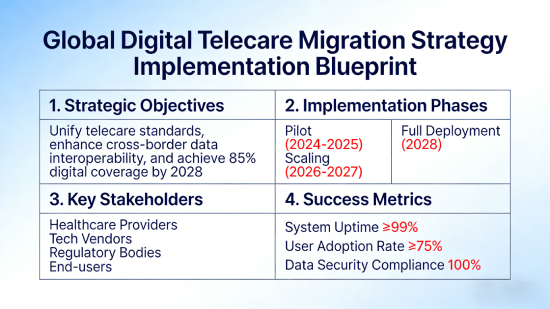
Global Digital Telecare Migration Strategy (Implementation Blueprint)
Step 1: Audit Analogue Dependencies
Map all PSTN-linked alarm systems.
Step 2: Risk Stratification
Identify high-risk residents requiring priority migration.
Step 3: Connectivity Testing
Perform signal audits for LTE-M/NB-IoT reliability.
Step 4: Pilot Deployment
Test telecare IoT infrastructure requirements in controlled rollout.
Step 5: Full Migration
Phased analogue-to-digital replacement with fallback redundancy.
Step 6: Continuous Monitoring Optimization
Refine escalation workflows and data analytics.
Market Trends & Strategic Outlook
-
Ageing population growth is driving assisted living technology demand
-
Increasing procurement requirements for IP-based telecare systems
-
Expansion of resilient IoT healthcare connectivity providers
-
AI-enhanced behavioral anomaly detection is entering telecare platforms
Telecare IoT is now viewed as critical infrastructure rather than an optional digital enhancement.
FAQ (Optimized for Rich Results)
What is a telecare IoT deployment model?
It defines how devices, connectivity, cloud platforms, and monitoring services are structured — managed, hybrid, or modular.
What are the telecare IoT infrastructure requirements?
Secure connectivity, certified devices, cloud redundancy, monitoring capacity, and compliance safeguards.
How does PSTN retirement impact telecare?
Analogue alarm systems may fail over digital lines, requiring migration to IP-based telecare systems.
What is a digital telecare migration strategy?
A structured plan to replace analogue telecare devices with secure IoT-enabled systems before full PSTN shutdown.
Conclusion
Telecare IoT is reshaping assisted living technology by integrating secure connectivity, cloud analytics, and scalable monitoring platforms. As analogue networks retire globally, understanding telecare IoT architecture, infrastructure requirements, compliance frameworks, and deployment models is essential.
Organizations that proactively adopt resilient IoT healthcare connectivity and structured migration strategies will mitigate PSTN retirement risks and future-proof their care services.